I pulled myself out of the shrubs and rolled onto the ground, sitting upright.
I looked down at my outstretched legs in disbelief—a six-inch-long, one-inch-deep cut slashed down my lower right leg. Clean.
The adipose tissue was exposed and glistening.
That’s not real. That’s not my leg.
Stuff like this doesn’t happen to me.
And then the thoughts flooded in:
The FKT I was chasing this morning? Not finishing that.
The FKT planned for ten days from now? That’s done too.
How will I get out of here? Can I even walk back to my car?
That’s a deep cut… did I hit something? Am I going to bleed out here?
So this is how it ends? Seriously?

The Wound Was Real. The Exit Plan? Improvised
I held my breath, opened my pack, and pulled out the first aid kit I’d thrown together the night before.
It wasn’t a priority—just a few things tossed in a baggie, “just in case” (because that stuff never actually happens). A token kit: athletic tape, scissors, a Wet One, and a buff.
Enough—barely—to tourniquet my leg, close the wound, and keep moving.
I pulled out my phone and opened the map. Ten miles back to my car if I stuck to the planned route. That’s at least a three-hour hike—if I was lucky. Would I make it before sunset? Would I even make it at all?
Frantically, I scrolled through the map, looking for a lifeline. Found one: a trailhead about 4K away at Kingsford Dam.
Then I did what all good wives do when they’re in real trouble:
I called my coach.
The Rideau FKT Was the Plan
The Rideau Trail had been on my radar since 2020.
Like most things, it started with my coach. We were north of Harrowsmith during my K&P Trail FKT that fall. Derrick caught up to me on his bike in the late afternoon as I descended the trail into Kingston. We passed a few side trails, marked with red triangles.
“That’s the Rideau Trail,” he said. “…next year.”
And next year it was—until a stress fracture in my left foot sidelined me in 2021.
Finally, in 2024, fresh off the Last Annual Vol State, the itch returned. It hit barely a week into recovery—that familiar tug to live on the road, to carry everything I needed on my back and just go.
August became a string of recon trips to Delta. I’d drop my bags at the cottage and head straight to the trail—sometimes hiking, sometimes running.
I parked at the finish, had my coach or husband drop me at the start. I’d highlight sections of the trail in my binder each night: areas I didn’t want to hit after dark, water sources, sleep spots. I weighed every piece of gear, watched videos on tarp tents, dehydrating food, even first aid kits—tourniquets? Why would I need that?
At first, I planned to go self-supported—stopping at stores along the way. But detours add up. And I knew myself: if I got near a McDonald’s, I’d be sitting there with a McFlurry and regret. (It’s happened before.)
So I switched to unsupported. Carry everything.
My coach added weighted pack to my training hike. At first, it felt weird.
“I’m a runner”, I thought.
But slowly, my mindset shifted. Every week, my pack got heavier with supplies and gear. I learned to slow down with intention. To move efficiently. To glide over roots and rocks, to fill water bottles from streams, to stop and take in where I was.
I started to feel at home out there.
Of course, I daydreamed. A lot.
The start line, the first sunset, the first sunrise, the peace, the fear.
I imagined scouting a picnic table in a small-town park, peeling off socks with sore feet and flagging motivation.
I pictured the excitement of hitting Freeman Road after leaving Gould Lake—the final rugged stretch before Sydenham.
And then that last push. Thirty kilometers of the familiar K&P trail to Kingston City Hall.
JUST FUCKING RUN.
In the weeks leading up to RTA, I showed up to my training session on fire—talking nonstop about gear, plans, water stops.
Jamie, my strength coach, stared at me with that look—the look of a lecture brewing.
“When you set expectations, you fall apart,” he reminded me. “When you just have fun, you nail it.”
I knew he was right. But still—
“I need to know where I’ll get water.”
“What happens if you run out?”
“I’m miserable until I find more.”
“Exactly. Just fucking run.”
That was the plan until August 30th happened.
Frontenac Perimeter FKT
When Derrick picked me up that Saturday morning at Frontenac Park, the plan was simple: a solid training hike. He dropped me 15 km away at a remote trailhead. A 2–3 hour hike back was on the books.
“I think you can break the Frontenac Park FKT,” he said. “It’d be a good test run before Rideau.”
As always, I nodded and pencilled it into my schedule—ten days before I was set to start the Rideau Trail.
Looking back, the signs were there that maybe I shouldn’t have done it. Not that day.
I ran out of time to prep on Thursday night. I was aiming for a 6 a.m. start but I woke up late, moved slowly, and arrived at Frontenac Park at 10 a.m.
I hadn’t even shared my plan with Sean. I just messaged him when I passed him on my way out.
At the trailhead, I stalled—adjusting my pack, double-checking gear, fussing over little things. Then I glanced at my inReach.
“Should I bring it?” I wondered.
“It’s only 46 km. Not like I’m running 100 miles.”
So I turned on messaging, set it to track my route, and tucked it in my vest, just in case.
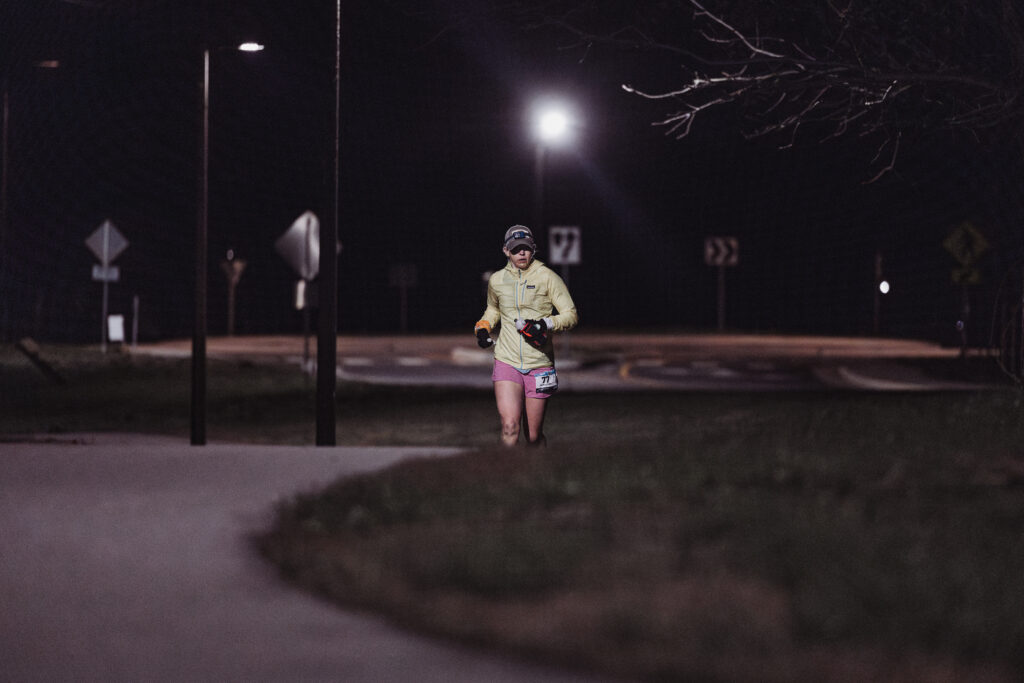
Eventually, I got moving. Slow jog to start, easing into the technical terrain. I chose counter-clockwise—get the tough stuff out of the way, then hammer the back half.
At the flagpole, I messaged Sean and Derrick my route so they could track me. Told my coach: “Started about an hour ago. All is well.”
I followed Jamie’s advice—don’t look at my watch…Okay, I looked. Twice.
The early terrain was slow, but I stayed calm. I’d make up time past Big Salmon.
And I was moving well. Rocks, roots, climbs—I was gliding, hiking strong. Pushing without pressure, just that familiar hum of racing again.
I stopped occasionally—water, snacks (Sour Patch Kids, obviously), and to soak in the views. I felt like myself again. The old trail-running Michelle.
And I started to daydream about that final stretch to my car:
Would it be a sprint? A grin to the finish? I felt the emotion rising. Another challenge, almost in the books.
At Big Salmon, I flew. Found my rhythm, pushing hard. I’d given myself six hours, with a 40-minute buffer. I was racing now. I was in it.
Then I tripped.
“No big deal,” I thought—until I felt the sting on my temple. I brushed it off and kept going.
Until kilometre 29.
That’s when I went down hard into the shrubs.
I rolled onto my back and started to stand. And that’s when I saw it.
A long, deep cut slashed clean down my lower leg. No blood yet. Just flesh, wide open.
It stared back at me—and I knew.
The run was over
The Aftermath
Of course, there was no cell reception.
I grabbed my satellite tracker and texted my coach. The message just sat there, spinning—unsent.
So I started hobbling. Slowly. Oddly enough, there wasn’t much pain—just the dull shock of it all. What really hit was the weight: my plans for the day, for the Rideau Trail, for the fall… all of it unraveling.
A few hikers passed. Smiled politely. No one stopped. I didn’t ask for help. I was fine—really. The only help I wanted was a teleport back to my car.
Eventually, I caught a blip of reception. I called Derrick. He barely heard, “I fell, I’m okay,” before the call dropped. Later, he got my location by text and jumped in his car—an hour away.
When I finally reached the parking lot, I collapsed onto the ground, legs stretched out in front of me. I stared at the mess: the blood-soaked Wet One, my favourite buff now shredded as a tourniquet, and what looked like a chunk of flesh stuck to my gaiter.
So I sat there, sipping filtered lake water, eating Sour Patch Kids and Skittles, just waiting.
Eventually, Derrick rolled in. His wife Sarah had packed a care kit—snacks, drinks, ginger beer. I grabbed one and some nuts and started telling the story, probably a little too casually for what had just happened.
“I’ll drive myself to the hospital,” I said, still in problem-solving mode. “Winchester ER should be quiet.”
Derrick shook his head. “We’re going to Napanee. Trust me—better option.”
Then came the kicker.
“Oh, by the way—I texted Sean after you called. I was seeing if you got a hold of him to see what was going on.”
Oh. Shit. There went my shot at Best Wife award. Not that I was ever in the running.
I still hadn’t told my husband. I planned to get to the car, clean up, and then call. I had it under control. No need to make him worry or give him fuel for a “I told you so” about how this stuff isn’t safe.
I held my breath and called Sean.
“I fell,” I said. “I cut my leg. I’m going to the hospital for stitches. It’s not bad. I’m fine. Really.”
A lie. It was a four-kilometre hike that took over an hour.
I rambled on during the drive about everything under the sun. Probably still in shock.
We swung by my car at Frontenac so I could grab my ID—and, of course, my laptop, notebooks, and textbooks. I figured I’d use the waiting room time to catch up on work, because that’s what I do. Keep moving and grinding.
We got to the hospital and sat in triage. Sean showed up—quiet, stoic.
“I’m sorry,” I said, holding back tears.
He didn’t say much. He didn’t have to. He wasn’t mad about the injury. He was mad he was the last to find out.
I had called my coach first because he gets it—the trails, the risks. Sean, on the other hand, loves safety, structure, predictability. Ultra running doesn’t check any of those boxes.
The triage nurse cleaned the wound and listened to the story. She knew the park. Then she mentioned something that gave me hope:
“The doctor on duty is an ultra runner.”
Thank God. Someone who might understand instead of scolding me.
Eventually, we were taken into a room. I sat on the bed. Sean sat in a chair. Quiet. Tired. Tense. As the hours passed, the tension was broken with his usual wisecracks about random stuff.
The doctor and nurse came in and out, checking in. Small talk about running. We were a break, I think—a distraction from the chaos of the ER.
When the doctor finally sat down to stitch me up, the ultra talk kicked in.
I told him what happened.
“Oh yeah… the Frontenac Perimeter. One of the women I run with tried to break that FKT. Missed it by minutes.”
We traded stories while he worked—three internal stitches into the fascial compartment. Fourteen external.
“You’re lucky,” he said. “Cut’s in a good spot—right between the muscles.”
Then he added, “Stitches can come out in ten days.”
Pause. I half-joked:
“Just in time to run the Rideau Trail.”
He gave me the look. You know the one.
Then he fitted me with an air boot—not for function, but to slow me down. To remind me that even the best plans can’t outrun the unexpected.
Coaches Are Athletes Too
I’d been obsessing over the Rideau Trail for years.
I did everything right. This was supposed to be my season.
But now? Wrecked.
I sat there, staring at my binder, flipping through notes, timelines, carefully planned water stops. All of it.
Why now?
I’ve worked too damn hard for this.
I told myself the cut wasn’t that bad. A few days off, tape it up, maybe downgrade the plan a little—I could still go after the FKT, right?
I tweaked the schedule. Clung to hope.
Thanksgiving weekend. That became the new plan.
I’ll be healed by then.
I’ll just bring extra layers, a mat to sleep on the cold ground, and long underwear. I can do it.
I have to do it. I’ve worked too hard to let this go.
The Club told me to rest. Stay off my feet. They hovered. Kept checking my wound. Kept saying it looked infected. It wasn’t. I had a job where I couldn’t sit down. A calendar packed end-to-end. I couldn’t afford downtime. The swelling was not subsiding, pulling on the sitches.
They didn’t get it. They still don’t.
They don’t know the drive. Or the doubt I carry every day. The fear that maybe I’m still that person I believed I was:
The one who dreams big but never finishes.
The one who is comfortable with doing the ordinary.
The one who was lazy and never amounted to anything
So I pushed. I held on.
But the healing was too slow.
The wound closed, but my fitness didn’t come back. And then the antibiotics wrecked my stomach. Everything started to spiral.
Two weeks before my rescheduled start date, I waved the white flag.
I surrendered. Not to weakness, not to fear.
To reality.
To injury.
To something I couldn’t push through, even if I wanted to.
And I let the dream go.
The day every athlete dreads
September 11th, 2024. Six weeks prior, this day couldn’t come fast enough.
But over those past twelve days since the injury, I was dreading it, mostly because of all the feelings it stirs up.
That day should have been the start of a 330 km journey.
Carrying everything on my back. Alone on the trails and roads.
No computer, no social media, no podcasts.
Just me, feral and free, for a few glorious days.
Instead? Appointments. Meetings. Emails. Social media posts. All the “comforts” of modern life.
I tried not to look at my watch or think about where I should have been—if only I hadn’t tripped.
If only I hadn’t done that FKT attempt.
If only…
That day is the day every injured runner dreads:
The day that should’ve been a celebration of months of hard work… but instead, it’s mourning what didn’t happen.

Everything happens for a reason… is bullshit.
It’s the kind of thing people say when they don’t know what else to say—when something goes wrong and there’s no easy explanation. I’ve heard it before. I’ve even said it.
But sitting on the trail that day, staring at the clean slice down my leg, feeling everything I’d built slip away—I wasn’t thinking about fate. I was just trying to breathe.
There was no silver lining in that moment. Just panic, and the cold shock of realizing the plan was gone.
Looking back, I still don’t believe that moment had some grand purpose. But it did teach me something I didn’t want to learn: that I’m not invincible.
Somewhere deep down, I still think I’m invincible. Nothing can happen to me. I didn’t treat the Frontenac Perimeter or even the Rideau Trail FKT attempt with the seriousness it deserved.
It was “just” 46 km. Estimated time? Six hours.
Just like Gatineau Park, right?
Nope.
Frontenac was a different beast—isolated, quiet, unforgiving. No cell reception. No clear exits. I underestimated it completely.
I’ve always believed nothing out there could shake me—vicious dogs, transport trucks, 2 a.m. motorcycles, even sleeping alone in a gravel lot.
But now?
Now, I jog the soft trails behind our house and catch myself holding my breath at the smallest things:
Roots.
Little roots.
And my brain flashes back:
What if the cut had been somewhere else?
What if I’d hit my head harder?
What if there hadn’t been a shortcut out?
Meaning isn’t something we’re handed. We shape it in the aftermath, when we figure out a new way forward or decide to do things differently.
Frontenac Park didn’t just chew me up. It sent me home with a message:
Get your shit together. Stay safe.